
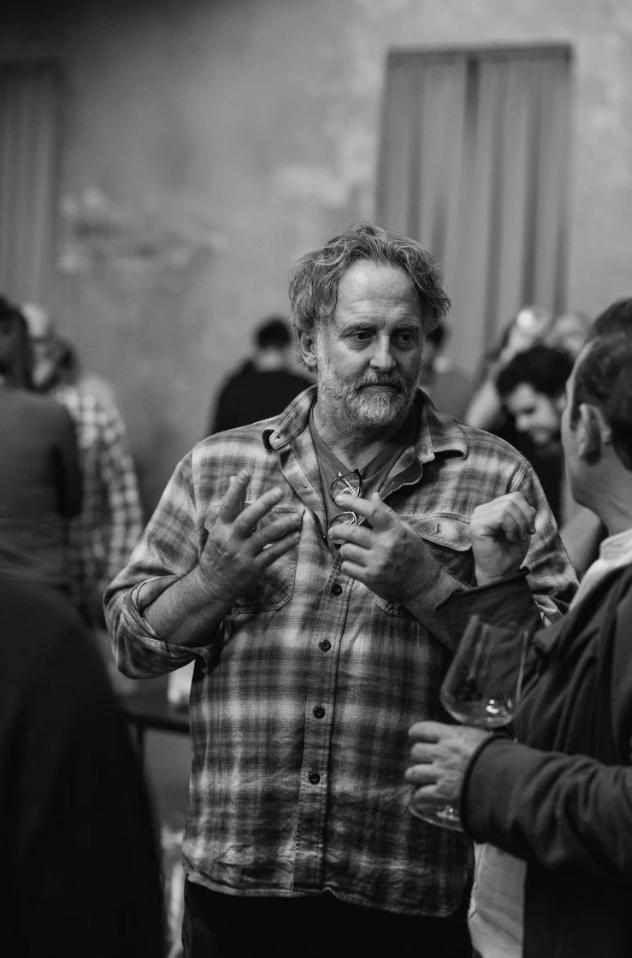
Photo Credit: Weinskandal, Austria
Domaine Matassa | Tom Lubbe
Roussillon | France
Tom Lubbe is a New Zealand-born winemaker who grew up in South Africa and helped pioneer a more natural, terroir-driven approach to South African wine. Early in his career he worked at the country’s only estate using indigenous yeasts and deliberately lower yields, a practice that influenced a new generation of producers — including Craig Hawkins of Testalonga — and helped reshape the South African wine scene.
Drawn to Mediterranean grape varieties, Tom secured a three-month internship at the acclaimed Domaine Gauby in Calce, France. Gérard Gauby soon invited him back as a cellar helper for three consecutive vintages, where Tom gained deep experience in low-intervention winemaking. While at Gauby he met his wife Nathalie, Gérard’s sister; the birth of their first child persuaded Tom to remain in Calce and establish his own domaine, Domaine Matassa.
Domaine Matassa covers 15 hectares: 13 hectares around Calce and 2 hectares higher in the Fenouillèdes. The Calce holdings sit on schist and marl soils and are planted with local Mediterranean varieties such as Grenache Gris, Macabeu, Muscat d’Alexandrie, Muscat Petit-Grain, Grenache Noir, Lladonner Pelut, Carignan and Mourvèdre. The high-altitude Fenouillèdes parcels feature wind-exposed, old-vine Carignan and Lladonner Pelut at 500–600 m on granitic soils. All vineyards are dry-farmed, bush-trained in the traditional gobelet style.
Tom manages his vineyards with strict natural and organic practices. Certified organic by Ecocert, he avoids chemical inputs and applies biodynamic techniques including Preparation 500 and plant-based fermentations to stimulate and nourish soil life. He is committed to biodiversity and moving beyond monoculture: he has planted seven local olive varieties intermingled deliberately like the region’s mixed old-vine plantings, and sows up to 15 different cover-crop species between rows to enhance soil microbiology and ecosystem resilience.
Domaine Matassa’s combination of Mediterranean varietals, low-intervention winemaking, organic and biodynamic farming, and a focus on biodiversity makes Tom Lubbe a notable figure in natural wine and sustainable viticulture in the Roussillon region.
Tom’s vineyard philosophy extends to the cellar, yielding mineral-driven, terroir-expressive wines. Healthier old vines and careful viticulture now let Tom bottle most wines under 10 mg/L total sulphur, showing greater vitality and balance. Whites often see skin maceration; reds are frequently whole-bunch fermented. Fermentations use native yeasts; wines are bottled unfined and unfiltered. Very low yields produce concentrated, mineral, site-specific wines. This evolution has earned acclaim from sommeliers and wine lovers worldwide.